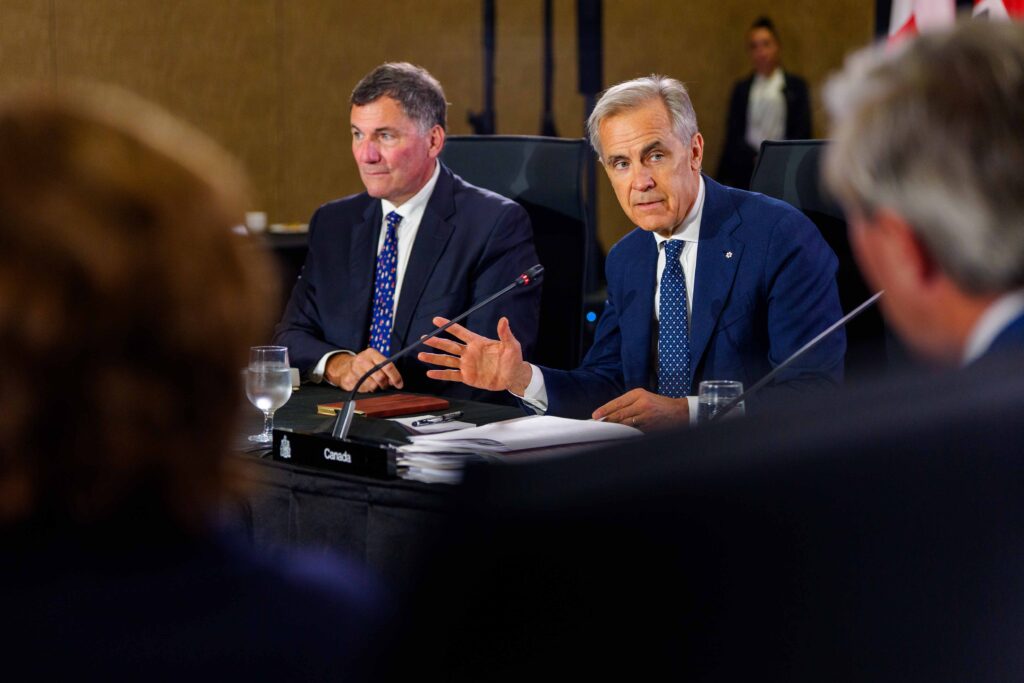
Prime Minister Mark Carney’s long-promoted Canada Investment Summit (“the Summit”) took place this week. Held in Toronto on September 14th and 15th, the invite-only Summit brought together roughly 100 of the world’s largest investors, pension funds, financial institutions, corporate leaders, and government officials (including former Prime Ministers Jean Chrétien and Stephen Harper) with a clear objective: working together to attract up to $1 trillion in foreign direct investment into Canada over the next five years.
The event reflected the Carney government’s broader effort to strengthen economic growth, increase domestic productivity, and diversify Canada’s relationships with global partners at a time of continued uncertainty and friction in Canada-U.S. trade relations.
What Was Discussed?
The summit largely reinforced, rather than expanded, Carney’s existing investment agenda. The 160-plus projects showcased to investors fell squarely within four priorities the government has already identified:
- Nation-building: major energy, critical minerals, transportation, ports, power and other infrastructure projects intended to expand Canada’s productive capacity.
- Defence and dual-use: investment in aerospace, shipbuilding, AI, cyber, robotics and other technologies under the Defence Industrial Strategy (DIS), linking defence procurement to broader industrial development.
- AI and emerging technology: investment in data centres, compute infrastructure and Canadian technology companies, consistent with the government’s AI strategy and its focus on building domestic capacity and scaling Canadian firms.
- Diversification beyond the U.S.: attracting capital from a wider range of international investors and positioning Canadian energy, resources, infrastructure and technology as part of supply chains serving Europe, Asia, and other markets.
The important point is that the summit was not about announcing new sectors. It was about testing whether Carney’s existing economic security agenda, building at home, strengthening strategic industries, and reducing dependence on the U.S., can attract the long-term private capital needed to execute it.
The Political and Economic Stakes
Media and policy commentators generally viewed the summit as a bold attempt to reposition Canada as a destination for large-scale private capital. Supporters argue that unlocking pension fund and institutional investment will be essential for building major infrastructure, developing Canada’s critical minerals, and supporting the country’s burgeoning AI ambitions.
However, the Summit also attracted criticism from labour, environmental, Indigenous, and social advocacy groups, who argued that decisions about major projects should not be driven by global investors. Protests outside the Summit highlighted concerns around fossil fuel development, privatization, and affordability, all issues that typically resonate with centre-left voters in Canada.
When Parliament resumes next week, Carney comes back with a reinforced majority, after the Liberals won all three byelections on August 31, including Chicoutimi–Le Fjord, which had been held by the Conservatives. That gives the government room to move on the economic agenda it has spent the past year developing.
The context, however, is very different from when that agenda was first laid out. Canada-U.S. relations remain unsettled, with tariffs in place and trade talks having broken down in August. Parliament now returns with Carney having to manage that relationship while also pushing the domestic investment agenda forward.
That makes the next two years relatively straightforward for the federal government: Use their parliamentary majority to get the major projects moving, build out the defence and technology industries the government has identified as strategic, and broaden Canada’s economic relationships beyond the U.S. The Investment Summit is one part of that effort. The harder part is turning the commitments and announcements into actual projects and investment.
What Happens Next?
The next test is execution. Ottawa has to move the projects highlighted at the summit through approvals, financing and construction, while turning the government’s commitments on defence, AI and infrastructure into contracts and investment.
We will watch for specific capital commitments, Major Projects Office decisions (including on the West Coast pipeline expected around October 1st), regulatory changes and evidence that projects are moving from the announcement stage to financing and construction. We will also be watching how recently announced strategies and project funding committed to in the government’s long-delayed AI Strategy and the Defence Industrial Strategy will play out. Investors will also be looking for greater clarity on timelines and approvals, particularly for large energy, mining, and infrastructure projects.
The Key Takeaway
The Canada Investment Summit represents a major political gamble by the Carney government. The Prime Minister is effectively arguing that attracting private investment at an unprecedented scale is essential to boosting productivity, strengthening Canada’s competitiveness, and insulating the economy from external shocks, including continued trade animosity with the US.
The summit was an attempt to put private capital behind Carney’s broader economic strategy: build more in Canada, strengthen strategic industries, and reduce the country’s exposure to the U.S. market. He now has a reinforced majority and a more unsettled Canada-U.S. relationship, giving the government both the political room and the economic pressure to pursue that agenda.
The measure of the summit will be what follows: whether Ottawa can get projects approved and built, whether Canadian companies can scale in areas such as defence and AI, and whether enough long-term capital comes into the country to make the government’s investment and diversification strategy tangible.
We’re Here to Help
For more information and insights about what these developments mean for Canada’s political landscape, please contact:
Jill Swenson – Senior Strategy Advisor, Ottawa
jill@prairieskystrategy.ca
Richard Truscott – Vice President, Alberta
richard@prairieskystrategy.ca
403.998.0494
Jeff Sterzuk – President
jeff@prairieskystrategy.ca
403.612.1724
Or contact a Prairie Sky Strategy Senior Advisor at info@prairieskystrategy.ca.
Photo Credit: Office of the Prime Minister