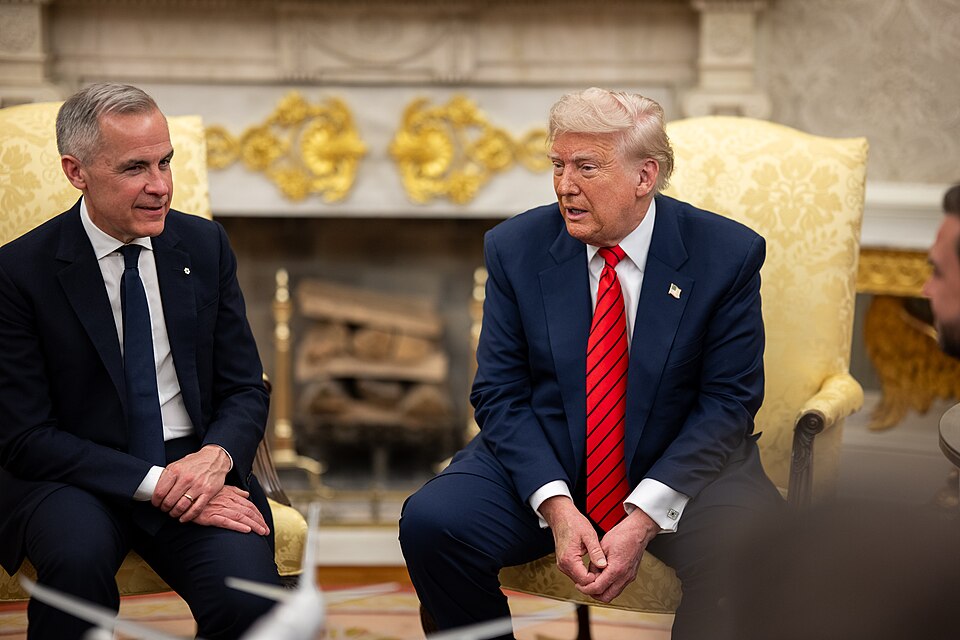
Yesterday, American President Donald Trump announced a new slate of 50% Tariffs to be imposed on Canadian goods. The announcement comes in the midst of heightened tensions with the President once again reiterating claims that Canada should become the “51st state,” as well as blaming Canada for the wildfire smoke which has covered much of the eastern United States in the last week.
This move is a significant re-escalation of trade tensions and seems to be part of a negotiating tactic by the President to gain leverage in the ongoing CUSMA talks that are increasingly in jeopardy. How the federal and provincial governments choose to respond will have wide ranging consequences for nearly every Canadian business sector.
What are the facts?
Trump “exercised his authority” under section 338 of the 1930 Tariff act to impose 50 percent tariffs on select Canadian goods that will come into effect within 30 days. In contrast, the Tariffs that were imposed in 2025, and struck down in February this year, were brought about through the International Emergency Economic Powers Act (IEEPA) of 1977. Until now, the 1930 Tariff act has never been used and is untested by the US court system.
Under the earlier 10% IEEPA tariffs, most goods could be exempted as long as they were compliant with the CUSMA rules of Origin. However, the new tariffs will apply to goods whether or not they are CUSMA compliant. Critical minerals, energy, fish and potash have been exempted from the new tariffs.
The Tariffs will be applied to a wide range of goods including these notable examples.
- Alcoholic beverages
- Dairy products
- Clothing
- Electronics
- Sports equipment
- Wood products
- Other organic products
- Tools and equipment
View the full lists here:
- New 50% tariffs on Canadian goods — Part 1 | PDF | Plants | Seed
- New 50% tariffs on Canadian goods — Part 2 | PDF | Wine | Brandy
- New 50% tariffs on Canadian goods — Part 3 | PDF | Milk | The United States
What is the context?
Officially, the Trump administration has listed three grievances as reasons for the new tariffs.
Vehicle manufacturing: Canada imposes quotas and tariffs on vehicles imported from the United States and over the last year, Canadian imports of American vehicles have decreased by 22%.
Alcohol bans: As a response to the original American tariffs, all provinces with the exception of Alberta and Saskatchewan halted the sale of American alcohol costing the U.S. beverage industry around $580 million over the last yar.
Dairy industry: The Canadian dairy industry is heavily regulated through quotas and import restrictions largely designed to protect Canadian farmers from foreign competition. This system overwhelmingly advantages Canadian producers within the Canadian market and has been a point of contention with the United States for years.
While not directly stated as a motivating factor in any official news release, another point of contention for the President has been the smoke from Canadian wildfires impacting American cities. Recently, the President has accused Canada of “poisoning our air” and suggested to reporters that Canada should pay pollution damages and that additional tariffs may be imposed because of the smoke.
The new tariffs also coincide with the announcement of an incentive program that would cut tariffs for aluminum manufacturers that build or refurbish plants within the United States. For context, in 2000, the United States was the world’s biggest producer of primary aluminium and 23 smelting facilities operated within the country. By 2021, the US produced less than 2% of the world’s aluminium and the number of smelters had dropped to six.
The Canadian aluminium industry has risen to fill this gap and currently supplies more than half of all the aluminium used in the United States. The move by President Trump to cut out Canadian producers represents a significant blow to the industry on top of the special tariffs on steel and aluminium.So far, the United Arab Emirates has announced an investment of $6 billion to construct an aluminium plant in Oklahoma (which will be the first new smelting plant in the country since 1980), further threatening Canadian aluminum producers.
What are the implications?
Initial responses from Canadian politicians have so far been muted. In the Prime Minister’s official statement, nothing much was said other than that CUSMA discussions will be “intensified” in the coming weeks.
This seems to be a signal that the Canadian government is willing to compromise in order to avoid escalating the trade war. Although more clarity on which direction the government chooses should be expected after the Council of the Federation meeting between Canada’s Premiers that concludes on Wednesday.
Canada, if it chooses to retaliate, holds significant trade leverage over the United States in key sectors such as energy. For instance, Canada supplies almost all of the natural gas and around 80% of all electricity imported by the United States. Any move to restrict or cut off the energy supply could theoretically cripple the American domestic economy. Regardless of how the government responds, these new tariffs are almost certain to raise costs for Canadians and Canadian businesses.
For more information and insights about what these developments mean for Canada’s political landscape, please contact:
Tariff Fact Sheets and CER Data
https://www.whitehouse.gov/presidential-actions/2026/07/imposing-additional-duties-to-offset-canadian-discrimination-against-the-commerce-of-the-united-states-with-respect-to-alcoholic-beverages/
https://www.whitehouse.gov/presidential-actions/2026/07/imposing-additional-duties-to-offset-canadian-discrimination-against-the-commerce-of-the-united-states-with-respect-to-motor-vehicles/
https://www.whitehouse.gov/presidential-actions/2026/07/imposing-additional-duties-to-offset-canadian-discrimination-against-the-commerce-of-the-united-states-with-respect-to-dairy/
CER – Market Snapshot: Overview of Canada-U.S. Energy Trade
We’re Here to Help
For more information and insights about what these developments mean for Canada’s political landscape, please contact:
Cameron Friesen – Vice President, Manitoba
cameron@prairieskystrategy.ca
204.332.1445
Jeff Sterzuk – President
jeff@prairieskystrategy.ca
403.612.1724
Ken Veldman – Senior Strategy Advisor, BC
ken@prairieskystrategy.ca
250.600.0670
Richard Truscott – Vice President
richard@prairieskystrategy.ca
403.998.0494
Or contact a Prairie Sky Strategy Senior Advisor at info@prairieskystrategy.ca.