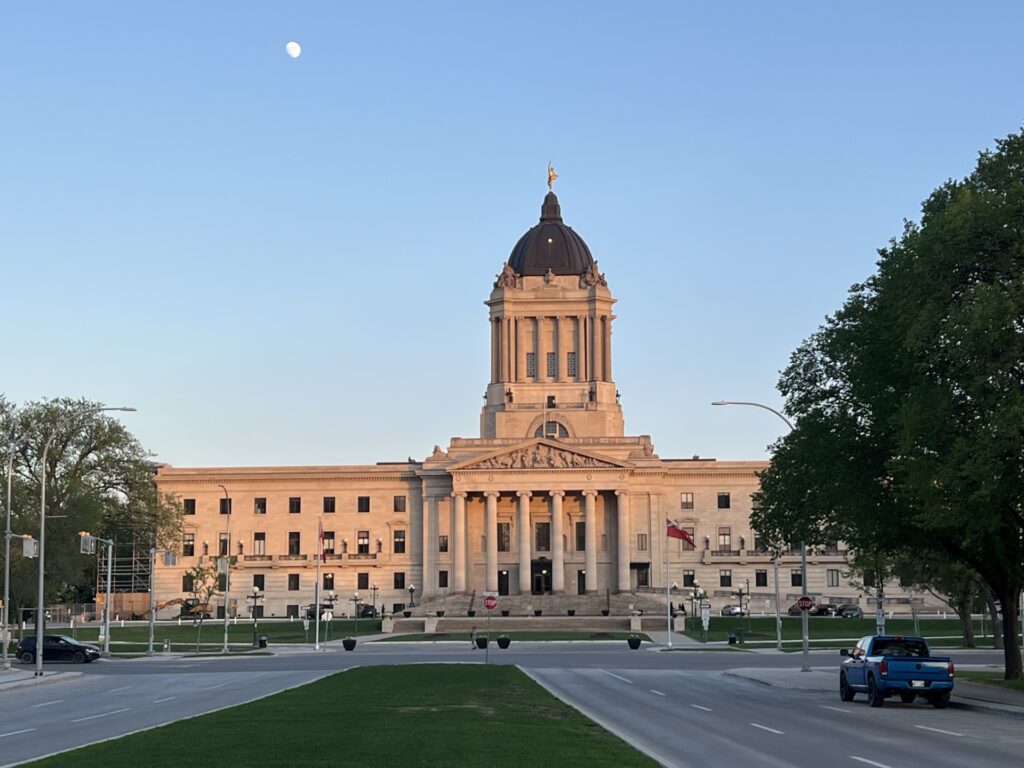
The Manitoba Legislature adjourned earlier today after a three-month session that focused heavily on addressing cost of living concerns, energy policy, and rising political tensions.
The government passed legislation to address grocery costs and curb energy demand tied to data centers and cryptocurrencies. At the same time, the session was also marked by deteriorating civility between Members of the Legislative Assembly (MLAs).
Affordability Measures:
The session was dominated by measures to counter cost-of-living concerns by waiving the PST on added grocery store items like soft drinks and snack foods. Although the policy got a bumpy ride by excluded groups, notably restaurants and convenience stores, the changes, included in the government’s budget bill, were passed after late night debate toward the end of the session.
Energy Policy and Data Centres:
A pair of energy bills took aim at data centres and cryptocurrencies by charging higher Hydro rates and allowing for curtailment during peak demand-measures intended to address projected energy shortages as early as 2032 as reported in Hydro’s new Integrated Resource Plan (IRP).
At the same time, the government moved quickly on new combustion turbine generation, with Manitoba Hydro’s proposal being sent to the Public Utilities Board. This doubling down on natural gas generation is a politically sensitive point given the government’s net zero commitments, as evidenced by the rough ride it received by NDP convention delegates criticizing the move as off brand.
Renewables and Indigenous Participation:
Meanwhile, the government’s renewable energy approach drew mixed reviews as a new Indigenous-led wind energy procurement was launched. The initial procurement, set at just 200 MW, received a cool reception, leading to speculation that the low-ambition roll-out was designed to curb the enthusiasm of one large developer and allow for broader participation by First Nations proponents who need more time to prepare bids.
Indigenous Policy and Churchill Strategy:
Conspicuously absent from the spring session was the Manitoba Crown-Indigenous Corporation (MCIC), hailed by Premier Kinew as a new way to facilitate Indigenous engagement and linked to the Churchill Plus project. The process appears to have got bogged down owing to complex governance issues and internal capacity on the file. In the meantime, the government offered a conciliatory gesture in the form of a new Indigenous Advisory Council on Hydro.
The NDP government continues to confidently promote Churchill Plus as their nation-building proposal, collecting MOUs and gaining headlines, although the barriers to a major play in Churchill are numerous. Last week, Sio Silica became the first company to express confidence in commercial viability of Churchill, pledging $125M for a silica sand port storage facility subject to approval of its environmental licence application; it’s a calculated risk given that the NDP government rejected Sio’s initial license application in 2024.
Social Policy:
The NDP has largely avoided major political pitfalls, but their promise of a drug consumption site is creating a growing risk. Initially promised in the last election, a first attempt was thwarted by community opposition. Their latest proposal was paused only days after a new Canadian study concluded that closing consumption sites did NOT in fact result in increased mortality or emergency service use for site users.
Political Climate and Civility:
Accounts of incivility in a provincial Legislature are not new, but the acrimony appears worse in Manitoba (veteran MLAs hint that decorum has never been as bad). Following weeks of attacks across the aisle, including bitter exchanges between Party Leaders, the NDP Speaker took the extraordinary step of banning the use of certain terms in an effort to curtail name calling, eliciting a sharp rebuke by the Premier.
The Premier continues to be personally popular at home and across Canada. He continues to gain attention on issues of importance, floating a ban on social media and AI chatbots for children, sipping Manitoba-produced Crown Royal in response to Premier Ford’s pouring-out-whiskey stunt, contradicting Alberta’s Premier Smith on Indigenous consultation in the referendum debate, and theorizing on ending daylight savings time.
Manitoba Jobs Agreement:
The Progressive Conservative (PC) Opposition gained traction late in the session by targeting the Manitoba Jobs Agreement (MJA), a procurement approach favouring unionized companies for large public infrastructure projects. Industry associations initially tried to engage the government on amendments to legislation that including mandatory union fees and restrictive bidding, then changed tactics and launched a “Red Flag” campaign, criticizing the government’s lack of consultation while warning of disastrous impacts on the construction sector. The MJA emerged as the first real test of this government’s popularity. While Premier Kinew retains considerable political capital, he has shown little willingness to back down, supported by labour groups seeking a clear win.
Bottom Line:
As Manitoba heads into summer, with a provincial election still more than a year away, the NDP government remains in a relatively strong political position. The party continues to perform well in key Winnipeg seats as well as parts of rural Manitoba.
The honeymoon may not be over yet, but the public is showing signs of dissatisfaction, calling for action on ER wait times, surgery wait lists, public safety and affordability. For the PC opposition, the path ahead is clear but challenging – organizing the party so it can deliver a counter narrative in the same urban and suburban riding it lost by slim margins in the 2023 election.
The legislative session revealed a government still benefiting from political momentum, but the final year of its mandate will be critical to show how the government withstands mounting pressures from fiscal realities, navigates contentious policy choices, and manages growing public expectations for results.
We’re Here to Help
For more information and insights about what these developments mean for Manitoba’s political landscape, please contact:
Cameron Friesen – Vice President, Manitoba
cameron@prairieskystrategy.ca
204.332.1445
Connie Tamoto – Senior Strategy Advisor
connie@prairieskystrategy.ca
204.918.0344
To learn more about Prairie Sky Strategy, please visit our website.