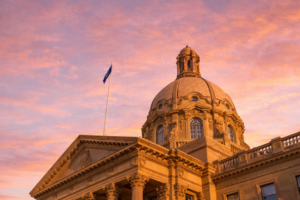
Alberta’s 2026–27 Budget was unveiled by Finance Minister Nate Horner at the Legislature in Edmonton today.
The new Budget arrives at a moment of profound recalibration for the province, not just fiscally, but demographically, politically, and economically as well. For many months, Albertans have been told to brace for sobering news. In his budget speech today, Finance Minister Nate Horner delivered exactly that: a second consecutive deficit budget shaped by significantly lower resource revenues amid the fading memory of billions in royalty windfalls that once defined Alberta’s fiscal identity.
Despite the mounting pressures, however, the government has drawn a firm line against tax increases, arguing that affordability concerns remain too acute for Albertans already struggling with rising costs.
In the lead up to the budget, Premier Smith had emphasized that Alberta’s challenges are not merely cyclical but structural, rooted in global volatility, weak oil prices, and what she called “unsustainable” population growth driven in large measure by flawed federal immigration policies. This influx of people, she argued, is straining the province’s capacity to deliver health care, education, social services, as well as build the required critical infrastructure to support that rapidly growing population.
Even so, Smith insisted that essential public services will be protected, pointing to the 7.2% increase in operating funding for the K-12 education system in today’s budget, as well as an overall $7.7 billion (22%) hike in physician funding, as evidence of the government’s commitment.
But with economists and analysts warning that Alberta must confront a long‑term revenue reality in which the province can no longer rely on extraordinary resource windfalls, the conversation is inevitably shifting toward how the government generates and sustains its revenue streams, in the face of continued fierce public resistance to a provincial sales tax.
Here are the highlights of Alberta’s 2026/27 Budget:
- Deficits are projected for the next three years: $9.4 billion, $7.6 billion, and $6.9 billion.
- Total revenue forecast for 2026/27 is $74.6 billion, down in large measure due to a $3.1 billion drop in resource revenues (budget assumption for the benchmark WTI oil is $60.50 US per barrel).
- Total expenses expected to increase $4.5 billion (or 5.6%) to $83.9 billion, driven by health care, education, public sector compensation, and a $2 billion contingency fund for emergencies.
- Government debt will continue to rise, with taxpayer supported debt expected to reach $108.9 billion and annual debt servicing costs increasing to $3.4 billion.
- Overall health spending reaches $34.4 billion, an increase of $1.9 billion or 5.8%, to support more surgeries, greater access to primary care, and new mental‑health and addiction treatment beds.
- Education operating funding will increase 7.2% to $10.8 billion, enabling the hiring of at least 3,000 teachers and 1,500 educational assistants, as well as $3.3 billion for school infrastructure, over three years.
- The Heritage Fund is expected to reach $34 billion by 2026‑27, with a long‑term goal of building a $250 billion fund by 2050 to stabilize Alberta’s finances and reduce reliance on volatile resource revenues.
- Three‑year Capital Plan will total $28.3 billion, largely focused on major investments in schools, hospitals, roads, bridges, and rural/urban health‑care infrastructure.
- Real GDP growth is forecasted to slow to 1.8% in 2026 due to global tariffs, trade uncertainty, and weak oil prices.
Taken together, Budget 2026 represents more than a fiscal plan, it signals a period of recalibration, in which the provincial government must reconcile declining royalties and rapid population growth with its ambitions for economic competitiveness, public service delivery, and long‑term fiscal stability.
In the days ahead, Prairie Sky Strategy’s experts will be exploring what this recalibration means for industry, communities, and the broader policy landscape, and most importantly, where strategic opportunities may emerge as Alberta navigates this new fiscal reality.
We’re Here to Help
For more information and insights about what these developments mean for Canada’s political landscape, please contact:
For more information and insights about what these developments mean for Alberta’s political landscape, please contact:
Rick Fraser -Senior Strategy Advisor
rick@prairieskystrategy.ca
403.701.7584
Whitney Issik – Senior Strategy Advisor
whitney@prairieskystrategy.ca
403.815.2582
Leigha Parsons – Senior Strategy Advisor
leigha@prairieskystrategy.ca
403.650.8191
Line Porfon – Senior Strategy Advisor
line@prairieskystrategy.ca
780.235.6267
Mat Steppan – Vice-President
mat@prairieskystrategy.ca
780.236.1543
Jeff Sterzuk – President
jeff@prairieskystrategy.ca
403.612.1724
Ben Thibault – Senior Strategy Advisor
ben@prairieskystrategy.ca
587.897.6261
Richard Truscott – Vice-President
richard@prairieskystrategy.ca
403.998.0494
To learn more about Prairie Sky Strategy, please visit our website.